
Last updated August 25, 2026
Free on-site gate assessment - hinges, posts, and your LiftMaster or Nice gate operator checked before anything is quoted
The assessment is free and the quote is the invoice.
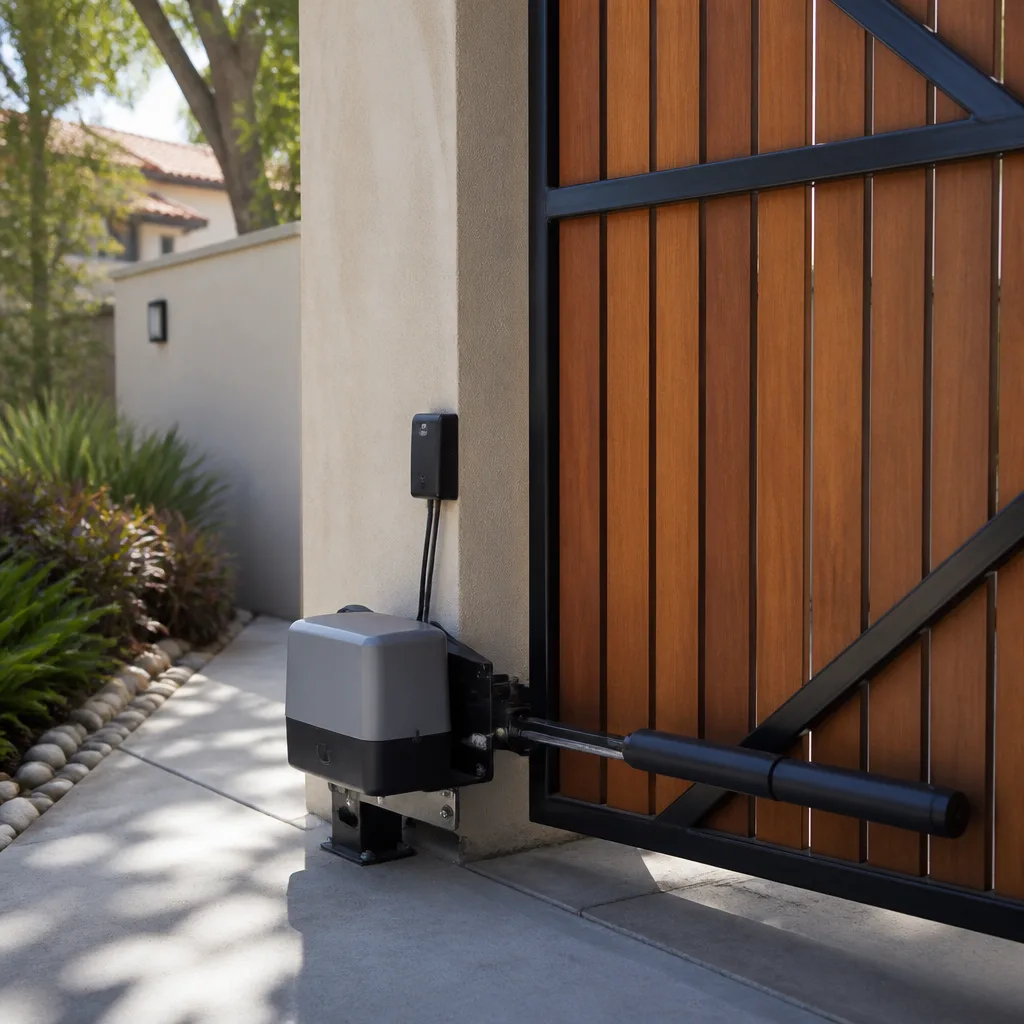
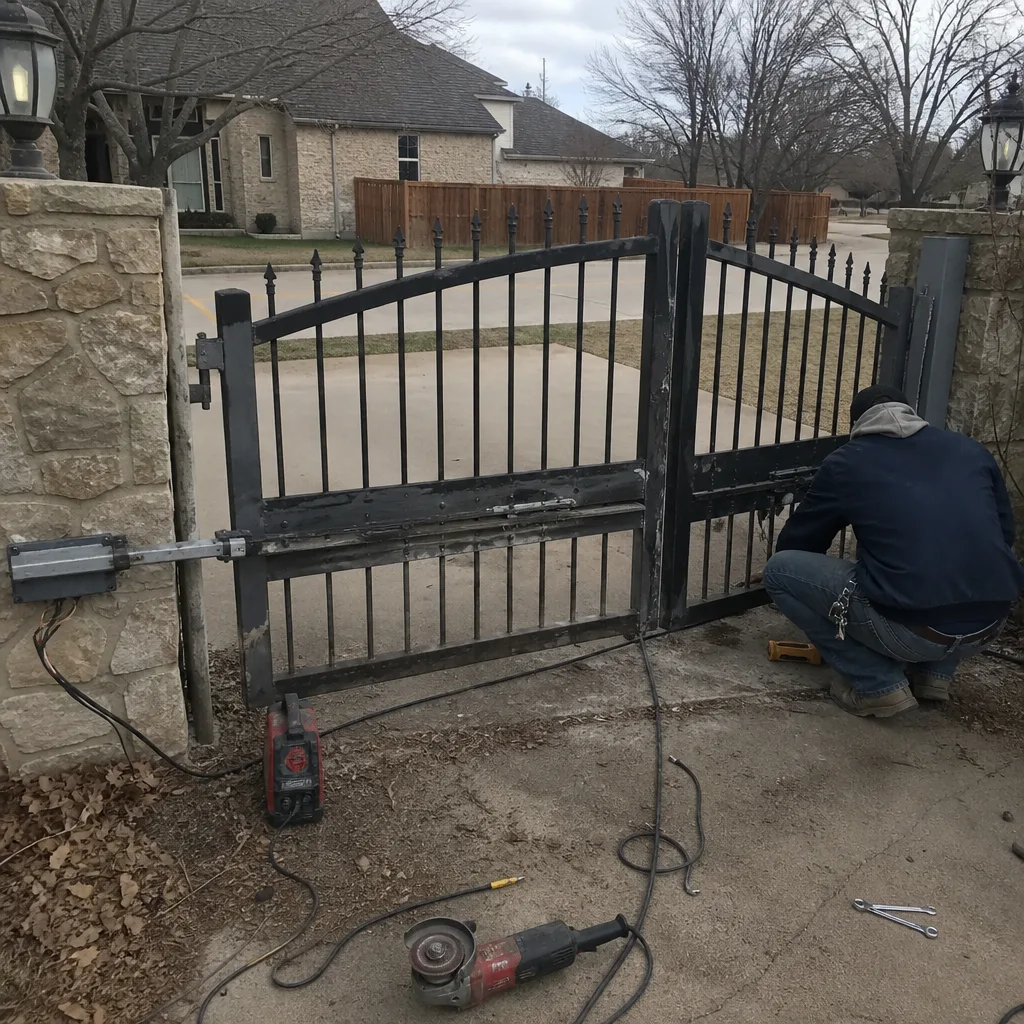 Before
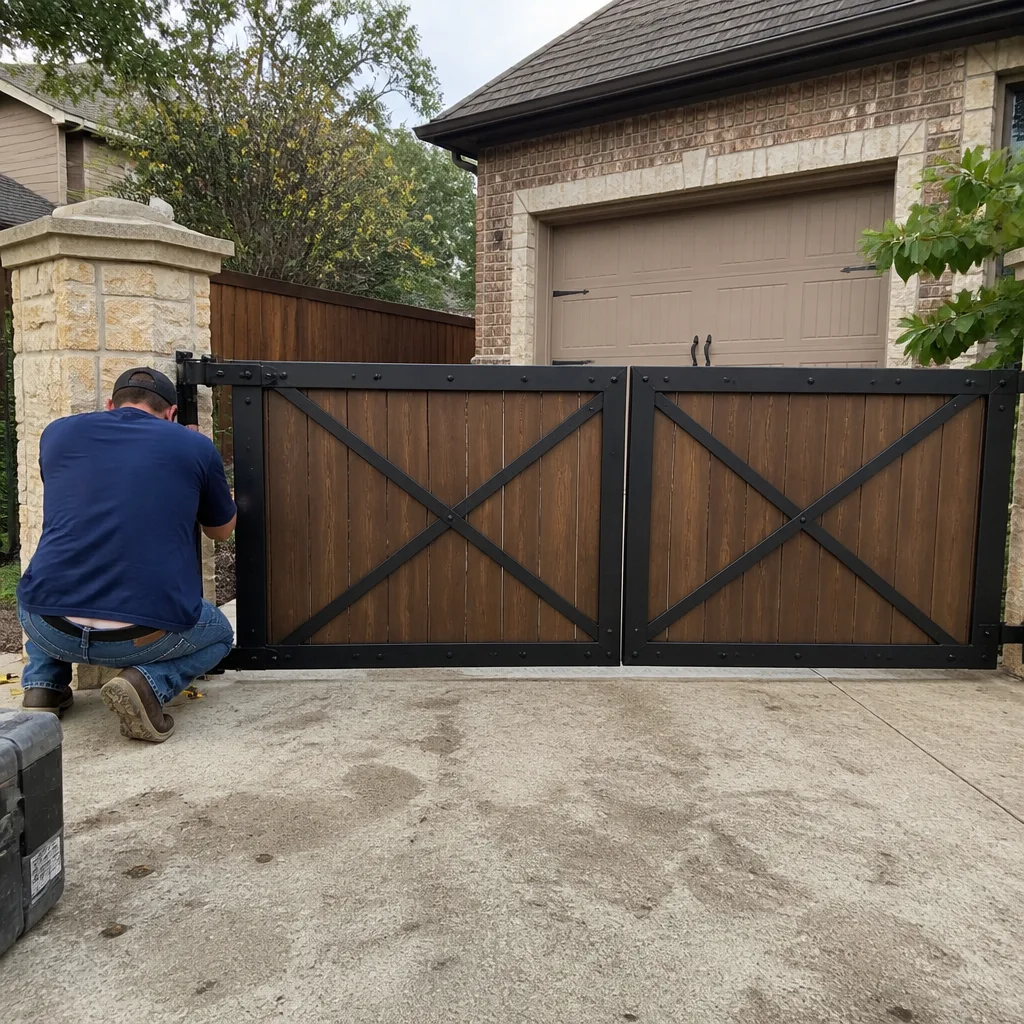 After
After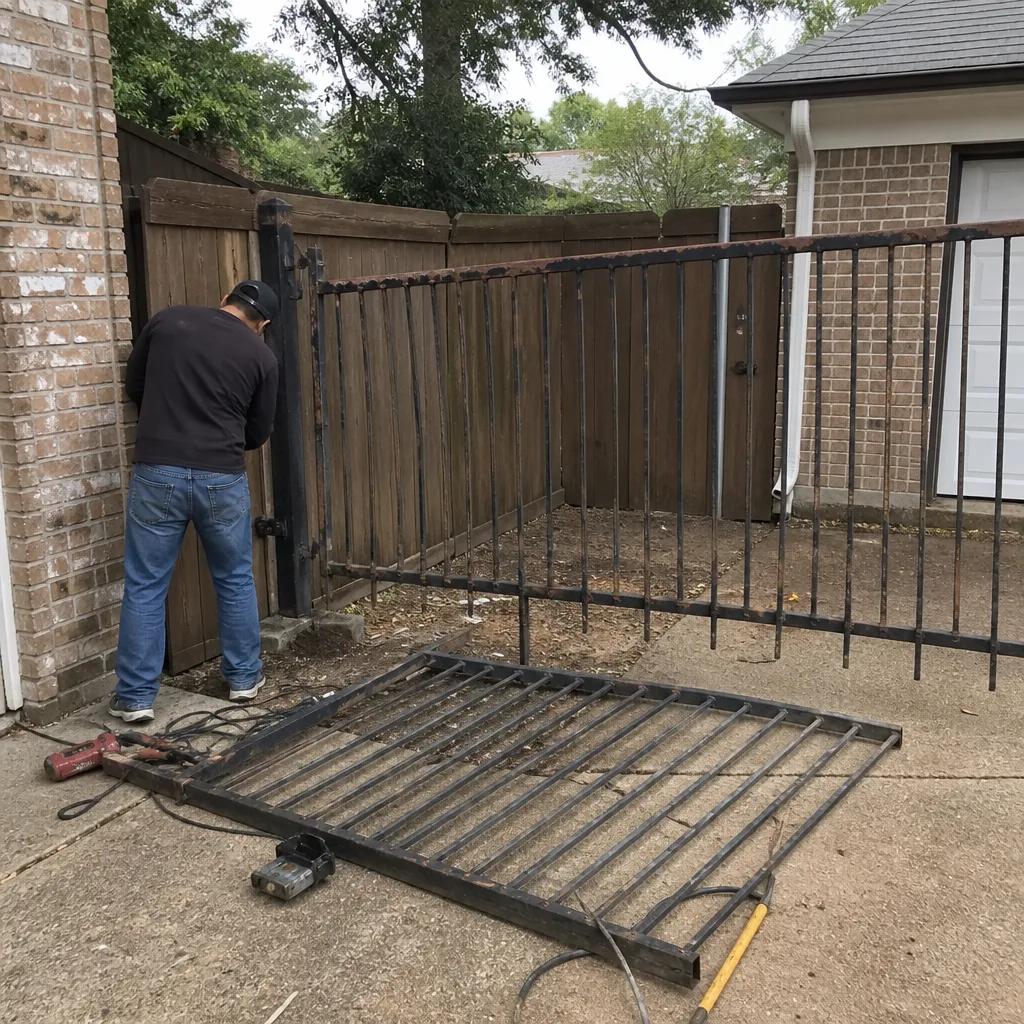 Before
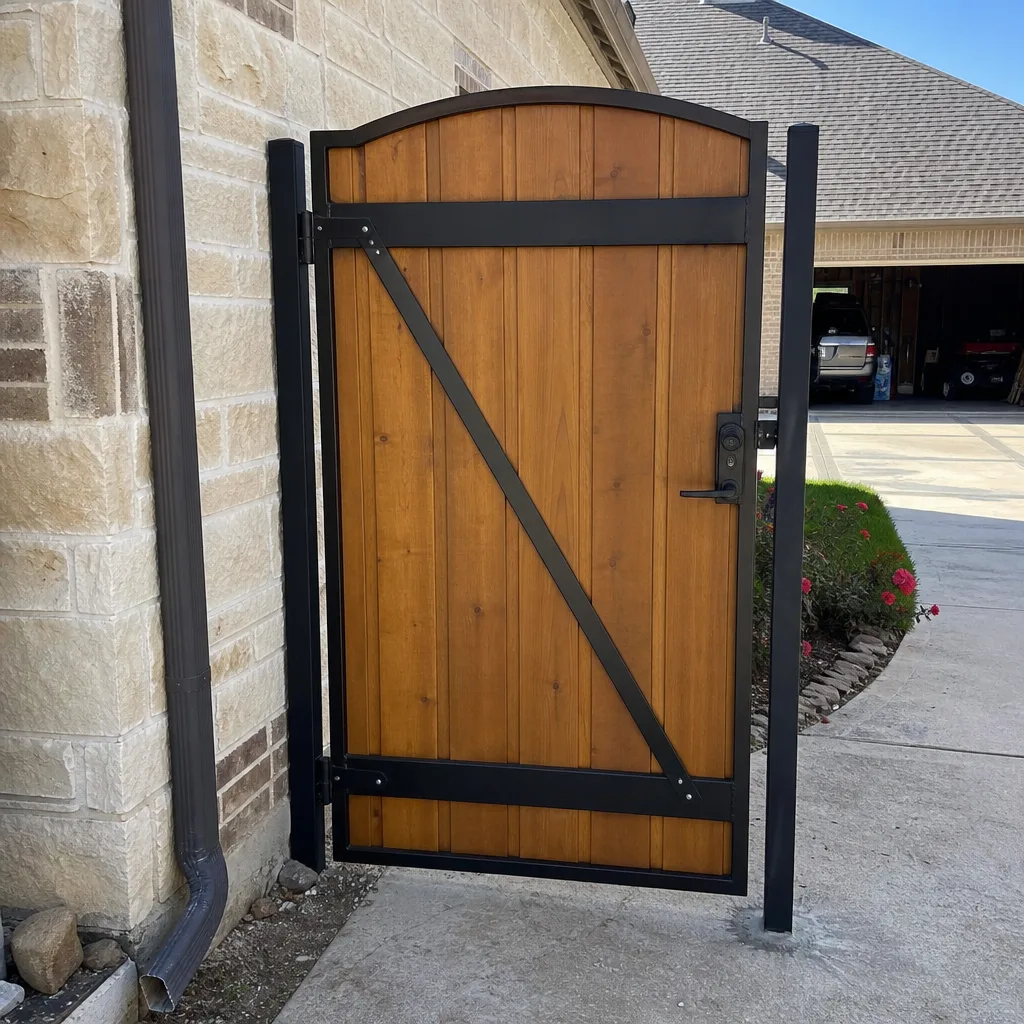 After
After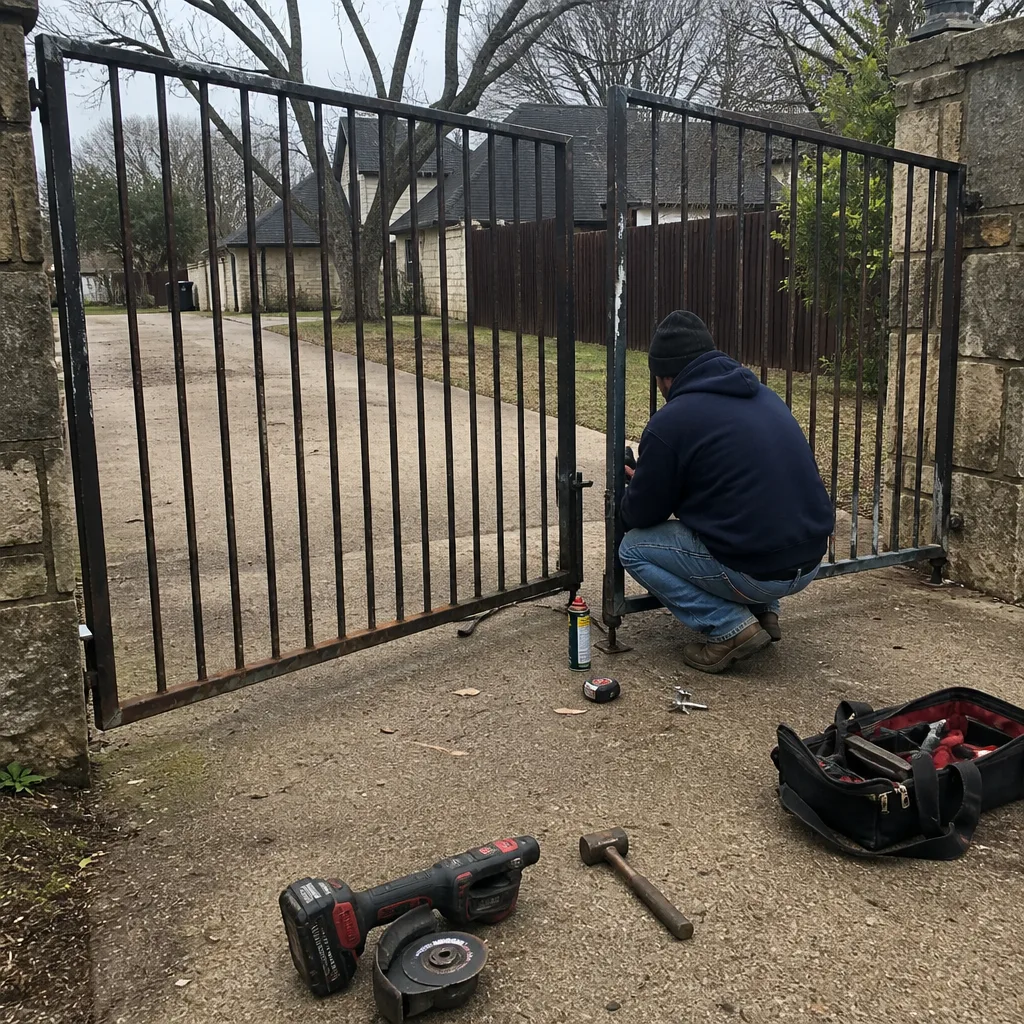 Before
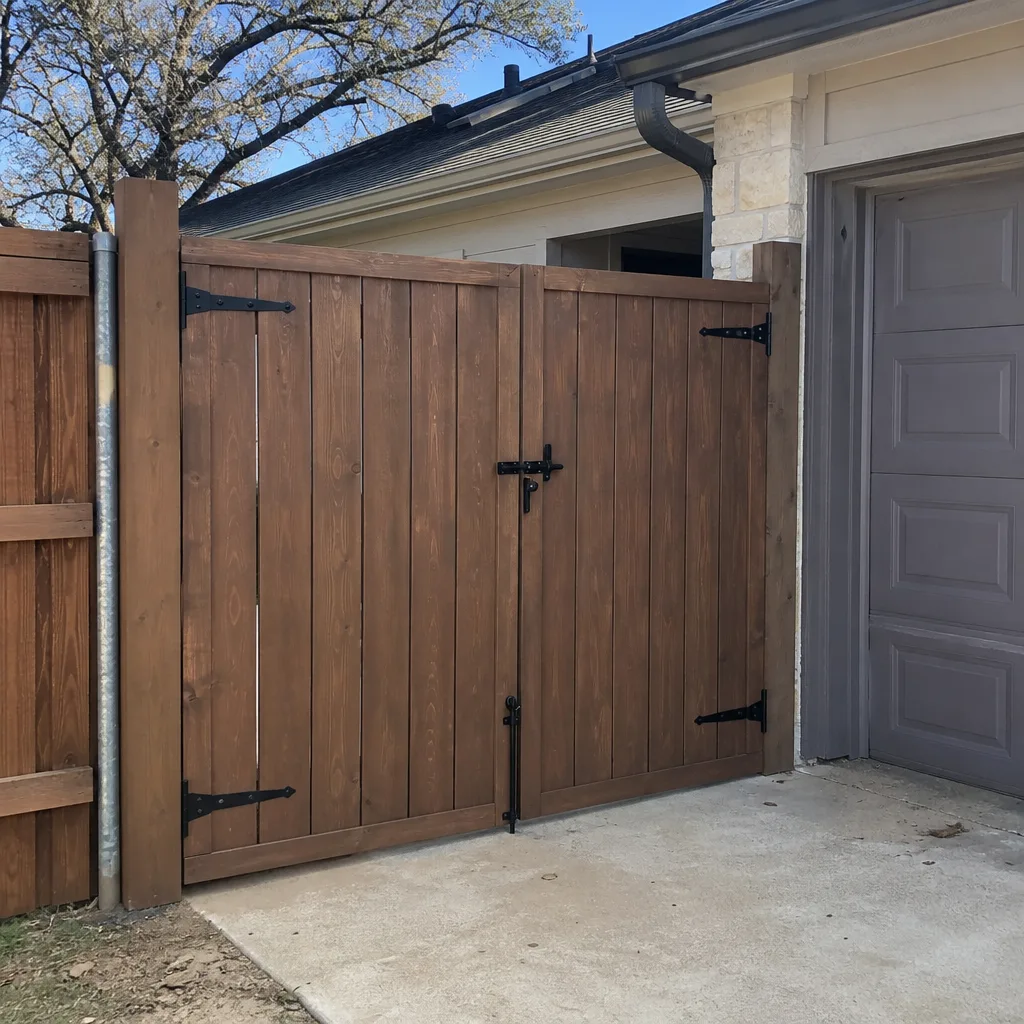 After
AfterDIY vs Professional Gate Repair: The Fort Worth Homeowner’s Decision Guide
Most automatic driveway gates in Fort Worth fail for the same three reasons: a dying capacitor in the motor, a misaligned photo eye, or a hinge that has been carrying too much weight for too long. None of these are complicated fixes for someone who does them every day. All of them have sent homeowners to the emergency room when attempted with a pry bar and a YouTube video playing in the garage. This guide walks you through what you can safely handle yourself, what you should never touch, and how Fort Worth’s punishing summer heat and shifting clay soil change the math on gate maintenance. By the end, you’ll know exactly where the line is between a Saturday project and a Saturday disaster.
Quick Answer
Simple cosmetic fixes and basic lubrication are reasonable DIY projects for most Fort Worth homeowners. Anything involving torsion springs, gate motors, electrical wiring, or a gate that has come off its track calls for a professional. In our experience, a gate that has shifted more than an inch out of level, makes a grinding noise, or refuses to close completely is already past the DIY stage.
Table of Contents
- What You Can Safely Fix Yourself
- What You Should Never Touch
- The Real Cost Comparison: DIY vs Professional
- How Fort Worth Climate and Soil Affect Your Gate
- Step-by-Step: The One DIY Job Worth Doing
- Step-by-Step: Diagnosing a Gate That Wont Open or Close
- What Those Opener Brand Names Actually Mean for Repair
- Common Mistakes to Avoid
- When to Call a Professional
- Frequently Asked Questions
- The Bottom Line
What You Can Safely Fix Yourself
There is a short list of gate problems that a careful homeowner can address without special tools or training. These are maintenance tasks, not repairs. They extend the life of your gate and keep small problems from becoming expensive ones. The key is knowing where the list ends.
The first item is lubrication. Every moving hinge, roller, and the track itself benefits from a light application of white lithium grease or a silicone spray twice a year. In Fort Worth, we recommend doing this in late spring and again in late fall. The summer heat thins out lubricants and the dust from dry weather turns old grease into a grinding paste. A gate that creaks every time it opens is telling you it needs attention. A can of proper gate lubricant costs under twenty dollars and takes about twenty minutes to apply correctly.
The second item is cleaning the photo eye sensors. These are the small plastic lenses mounted low on either side of the gate, usually wired to the opener. Fort Worth dust, grass clippings, and the occasional spider web block the infrared beam. When the beam is blocked, the gate refuses to close. This is by design. It is a safety feature, not a malfunction. A soft dry cloth wipes the lens clean in seconds. This is the single most common service call we receive that turns out to be fixed in under a minute.
The third item is hardware tightening. Walk the length of the gate and check every visible bolt, screw, and bracket. Use a wrench, not a drill. The goal is snug, not over-torqued. In neighborhoods built on expansive clay soil, like many parts of Fort Worth between the Trinity River and the eastern city limits, gate posts shift seasonally. Loose hardware accelerates that shift. A ten-minute walk with a wrench twice a year prevents a lot of gate sag.
That is the complete DIY list for most homeowners. Everything beyond lubrication, sensor cleaning, and basic tightening involves force, tension, electricity, or alignment.
What You Should Never Touch
Automatic gates contain dangerous stored energy. The springs, cables, and motors that make a gate move hold tension that can release suddenly. We have seen a gate spring break loose and send a steel bracket through a garage wall. A homeowner standing in the wrong place at that moment would not have been able to react in time.
Torsion springs are the top of the never-touch list. These are the heavy coils mounted near the hinge side of the gate, wound tight to balance the gate’s weight. They carry thousands of pounds of tension. When they break, they do so violently and without warning. Replacing them requires a winding bar technique that takes years to learn and still injures seasoned technicians who get complacent. Do not attempt to adjust, remove, or even closely inspect a torsion spring. If the gate sags on one side or the spring looks stretched or separated, step away and call someone who does this work for a living. There is no repair that justifies the risk of a broken arm or a lacerated face.
The second dangerous component is any electrical wiring connected to the gate opener. This includes the low-voltage wire running from the house to the operator, the power cord to the motor, and the wiring for keypads and loops. A 24-volt low-voltage wire will not shock you badly. But the line voltage powering the operator absolutely can. More importantly, incorrect wiring can energize the gate frame itself or create a fire hazard inside the operator housing. If a breaker trips when the gate activates, do not reset it and try again. That breaker is telling you something is wrong down the line.
The third category is any gate that has come off its track. A gate that jumps its track is out of alignment and fighting its own weight. Lifting it back into place by hand is a shoulder injury waiting to happen. Even if you get it back on, the underlying misalignment remains. The gate will come off again, probably when a car is halfway through the opening.
The fourth is hydraulic gate operators. These use compressed fluid to move heavy gates. Opening a hydraulic line releases oil under pressure at a high enough PSI to inject fluid under your skin. That injury requires immediate surgery.
We are not trying to scare you away from ever touching your gate. We are trying to keep you from a hospital visit. Call a professional for springs, electrical, track realignment, and hydraulics. Every time.
The Real Cost Comparison: DIY vs Professional
Homeowners usually think they are comparing a twenty-dollar part from the hardware store to a service call with a shop rate attached. That comparison is wrong. The real comparison includes your time, your tools, the risk of making the problem worse, and the cost of doing the job a second time when the first attempt fails.
A DIY gate repair in Fort Worth typically costs between $30 and $200 in parts. That buys lubricant, replacement hinges, a new sensor, or a generic circuit board ordered online. What it does not buy is the knowledge of which part actually failed. We see homeowners replace a circuit board when the real problem is a motor drawing too much current and frying the board. They spend $140 on the board, an afternoon installing it, and burn out the new board within a month.
A professional gate repair in Fort Worth typically runs from $150 to $900 depending on the failure. A simple sensor replacement is at the low end. A full operator replacement on a heavy estate gate can run higher. The difference is that a professional diagnosis identifies the actual failure. The fix holds. And if it does not, a company with a written guarantee comes back and makes it right without charging for the follow-up.
| Repair Type | DIY Cost (Parts Only) | Professional Cost (Parts & Labor) | Typical Failure Point |
|---|---|---|---|
| Photo eye sensor replacement | $25-$75 | $150-$275 | Wrong sensor wired incorrectly, gate still won’t close |
| Hinge replacement (standard single gate) | $40-$120 | $225-$400 | Weld breaks, gate drops, frame cracks |
| Circuit board replacement | $100-$200 | $275-$500 | New board burned out by the underlying motor problem |
| Gate off track / realignment | $10-$50 (shims, bolts) | $200-$450 | Gate re-derails, damage to vehicle or fence |
| Torsion spring replacement | $50-$100 | $350-$700 | Serious injury during installation |
| Operator motor replacement | $250-$500 (generic) | $600-$1,400 | Wrong operator size, premature failure |
The hidden cost on the DIY side is the do-over. A hinge replacement that fails in six months means buying another hinge and doing the job again. A circuit board that shorts out because the motor was the real problem means you have now spent more than a professional repair would have cost and your gate still does not work. Our most expensive warranty work is, consistently, fixing DIY repairs that made the problem worse.
How Fort Worth Climate and Soil Affect Your Gate
Fort Worth is hard on gates in ways that other parts of Texas do not experience. The combination of expansive clay soil, severe summer heat, and periodic ice storms creates a unique set of failure patterns that a generic online tutorial rarely addresses.
Clay soil is the root cause of most gate misalignment in Fort Worth. The dark, heavy clay that runs through much of Tarrant County expands when wet and shrinks when dry. A gate post set in that soil moves through the seasons. After twenty years of freeze-thaw and wet-dry cycles, a post can lean several degrees out of plumb. The gate follows the post. Hinges bind. The load shifts. Think of it this way: the gate you installed was designed to hang from a vertical post. The gate you have now is hanging from a post that is no longer vertical. Everything downstream from that wears out faster.
Summer heat is the second factor. Fort Worth regularly sees stretches above 100 degrees, and the asphalt on a west-facing driveway can push 150. Gate operators installed without adequate ventilation cook their circuit boards. Capacitors, the components that give the motor its starting jolt, fail more often in heat. Rubber and plastic components degrade faster. A gate motor that lives in a black metal housing on the south side of the property is operating in a much hotter environment than its rated specifications assume.
Ice storms like the one Fort Worth experienced in February 2021 present a different challenge. Ice loads a gate with hundreds of extra pounds of weight. Motors sized for normal operation stall against the frozen mass. The safety features that prevent a gate from closing on a car can prevent it from closing on a sheet of ice. We tell homeowners to leave the gate open during freezing precipitation and close it when the thaw arrives. Forcing an iced gate is how motors burn out and chains snap.
A Fort Worth-specific maintenance schedule addresses all three. Check for post movement every spring. Service the operator before July. Prepare for freeze events in December. That rhythm matches the climate we actually live in.
Step-by-Step: The One DIY Job Worth Doing
Lubrication is the highest-value maintenance task a homeowner can perform. It is safe, inexpensive, and prevents the friction damage that leads to expensive failures. Here is the correct sequence, refined over 42 years of watching gates get lubricated incorrectly.
- Open the gate fully and disconnect the power. If your operator has a manual release, use it. You want the gate stationary while you work. Never lubricate a gate that could activate while your hands are near the moving parts.
- Clean the track first. Run a dry rag or a small brush along the full length of the gate track. Remove dirt, leaves, and the crusted mixture of dust and old grease that accumulates in Fort Worth’s dry summers. Adding new lubricant on top of grit turns it into sandpaper.
- Apply white lithium grease to the hinges. A thin coat on each hinge pin and the surface where the two hinge leaves meet. Less is more. You want a film, not a gob.
- Apply a silicone spray to the track and rollers. Silicone does not attract dust the way oil-based lubricants do. In Fort Worth, dust attraction is the difference between a quiet gate and a grinding one within a month.
- Apply a light machine oil to the chain drive if your operator uses one. A few drops along the length of the chain, not a full soak. Wipe away excess.
- Test the gate. Reconnect power, close the gate, and open it again. Listen. A properly lubricated gate makes a low, smooth sound. If it still grinds, the problem is alignment or weight distribution, not lubrication.
Skip the spray lubricant labeled for automotive use. It will loosen rust in the short term and attract dust in the long term. Buy a gate-specific lubricant or a general white lithium grease and a silicone spray. Combined cost is under twenty dollars at any hardware store in Fort Worth.
Step-by-Step: Diagnosing a Gate That Wont Open or Close
Before calling anyone, run through this diagnostic sequence. It identifies the simple fixes and gives you useful information to relay on the phone. The sequence moves from least invasive to most involved.
- Check the photo eyes. Look at both sensor lenses. If one is dusty, covered in grass, or partially blocked by a yard tool leaning against the fence, clean it and try the gate again. If the gate closes now, you fixed it. If one of the small indicator lights on the sensor is blinking, the sensor itself may be failing.
- Check the breaker. Find the breaker that serves the gate operator and verify it has not tripped. If it has, flip it back and try the gate. If it trips again immediately, stop resetting it. There is a short somewhere and every reset risks fire or equipment damage.
- Check the keypad and remote batteries. A keypad with a faded display is not getting power. A remote that worked yesterday and does not work today usually needs a battery. On some models, the gate will still open from the keypad when the remote battery is dead. This tells you whether the failure is in the control input or the operator itself.
- Listen for the motor hum. Stand near the operator and activate the gate. A low hum with no movement means the motor is powered but cannot move the gate. That points to a capacitor failure, a seized drive, or an obstruction. A complete silence means no power is reaching the operator.
- Look for physical binding. Inspect the gate track for debris. Look at the hinges for signs of sagging. Try to identify where the gate’s movement is stuck. If the gate is visibly leaning, the problem is structural.
- Write down what you observed. The order of the symptoms matters. A gate that opens but does not close is a different failure than a gate that does not open at all. A technician can diagnose faster and fix more accurately when you can describe the sequence.
If the photo eyes are clean, the breaker is fine, the batteries are fresh, and you have already lubricated the track, the remaining possibilities are motor, capacitor, circuit board, or structural. All four are professional territory.
What Those Opener Brand Names Actually Mean for Repair
Driveway gates in Fort Worth run on a mix of opener brands, and the brand on the housing determines how a repair should be approached. A technician trained on one brand’s quirks can misdiagnose another brand’s failure mode. This is one of the quiet advantages of working with a specialist rather than a general handyman.
DoorKing and Elite operators are common on older estate properties and commercial-style residential gates. These are heavy-duty units built for frequent cycling. They use proprietary circuit boards and specific voltage requirements. A generic replacement board from an online retailer may fit the housing and still fail because its tolerances are slightly wrong. DoorKing’s older models respond differently to sensitivity adjustments than the newer ones. Elite operators are known for chain and sprocket wear patterns that a brand-trained technician recognizes by sound.
Ghost Controls and Mighty Mule are the most common brands on DIY-installed residential gates. Homeowners buy them at farm supply stores and install them over a weekend. They are genuinely functional openers for light to medium gates, and the installation manuals are clearer than most. The weak points are the plastic gears and the circuit boards responding poorly to power surges. Fort Worth’s electrical grid sees enough thunderstorm activity that surge damage is a recurring issue on these units. A Ghost Controls opener that works fine after a storm and fails a week later likely took a surge hit that is now showing up as a motor controller failure.
The practical point: your opener brand determines parts availability, diagnostic approach, and whether a repair makes sense economically. A trained eye can tell you in five minutes whether your DoorKing is worth rebuilding or needs replacing, based on the specific revision of the board and the condition of the drive components. That recommendation is not a guess. It comes from having opened hundreds of these units.
Ironworks Gate Co. home service covers all of these brands and more. We settled on a standard list of nine brands we train on routinely so that when we arrive at your driveway, we know what we are looking at.
Common Mistakes to Avoid
- Adjusting the force setting to force a gate to close. When a gate bumps into an obstruction and reverses, the correct response is to find the obstruction. Turning up the force dial until the gate bulls through is how crushed bumpers and injured children happen. The force setting is a safety calibration, not a convenience knob.
- Replacing the battery in a solar system before testing the panel. A solar gate opener that fails at night but works during the day usually has a dead battery. But if the panel is placed in shade or angled wrong, a new battery will die too. Test what is failing before spending money on the part that is not.
- Using WD-40 on gate hinges. WD-40 is a solvent and light lubricant, not a gate grease. It displaces moisture and then evaporates, leaving the hinge drier than before. Use white lithium grease or a dedicated gate lubricant.
- Lifting a gate back onto its track by hand. A gate that has jumped its track is a structural failure signal. Lifting it back into place risks a back injury, a damaged track, or a gate that collapses while someone is passing through it. The track does not jump; the gate is telling you that the alignment has failed.
- Bypassing the photo eye to get the gate to close. Twisting the sensor wires together or taping the sensors face-to-face defeats the single most important safety feature on the gate. If the sensors are misaligned and you cannot get them to align, call someone who can. A gate that closes on a person is not a repair project; it is a life-altering injury.
- Assuming the cheapest estimate is the right choice. Fort Worth has no shortage of one-truck operators who will quote a gate repair at a price too good to pass up. The repair holds for three months and the truck has a new phone number. A written guarantee with a company that has answered the phone for decades is worth the difference in price.
When to Call a Professional
Call a professional when the gate involves a spring under tension, a motor that hums but does not move, a circuit board that has failed twice, or any gate that has come off its track. Call when you have already tried the simple fixes and the problem persists. Call when the gate is swinging freely and you cannot keep the grandchildren away from it. A gate that does not close is a security problem. A gate that closes unpredictably is a safety problem. Both are worth the cost of a competent repair.
Ironworks Gate Co. offers free estimates in Fort Worth. Call (817) 562-7979 and describe what the gate is doing. We will tell you over the phone what is safe to try yourself and what is not. If it needs a professional, we will give you an upfront price before any work begins and we will stand behind it with a written 90-Day Done Right Promise.
Frequently Asked Questions
Most gate repairs in Fort Worth fall between $150 and $900 depending on the failure. A sensor replacement is at the low end, a full operator replacement at the high end. The price is quoted and agreed before any work starts, so the bill you receive matches the number you approved. Call (817) 562-7979 for an exact quote on your specific gate.
You can replace remote batteries, clean photo eye sensors, and lubricate the track yourself. You should not open the operator housing, replace the circuit board, or adjust the force settings unless you have specific training on that brand. The components inside the housing carry line voltage and the motor stores residual charge even when the breaker is off.
Most single-gate repairs are completed in one visit. A hinge replacement or sensor swap takes about an hour. A full operator replacement on a standard residential gate takes two to three hours. If parts need to be ordered, the wait depends on the manufacturer, but most common parts for the brands we service are available locally in Fort Worth or within two business days.
Fort Worth’s clay soil moves more in winter when wet weather expands the ground. The post shifts enough to bind the gate. The colder temperatures also thicken lubricants and stress older capacitors, which fail more often when cold. The gate was not repositioned; the conditions around it changed. A post that has shifted needs a structural adjustment, not just a force setting change.
Fort Worth gets enough direct sunlight that a properly sized and positioned solar system works most of the year. The weak point is the battery, which typically needs replacement every two to three years. Shade from a large oak tree or a west-facing fence reduces the solar output enough to leave the battery undercharged. If your property has reliable AC power near the gate, a wired operator is the more durable choice.
First, set the gate to a fully open position and disconnect the power at the breaker. Do not try to recalibrate the closing pressure by forcing the gate down. The safety sensor or loop detector has failed or lost alignment. A sensor that fails intermittently is worst: the gate works correctly fifty times and then closes on something. This is a repair worth scheduling immediately. Call (817) 562-7979 and we will walk through the safe steps on the phone.
The Bottom Line
You can safely maintain your Fort Worth gate by lubricating it twice a year, cleaning the photo eyes, and keeping the hardware tight. That work prevents many failures before they start. When something actually breaks, the repair belongs to someone who does it every day. The danger of stored tension, the complexity of electrical diagnosis, and the cost of a failed DIY attempt all point the same direction. A written guarantee from a company that will answer the phone when you call is worth more than saving $80 on a part. We have been fixing Fort Worth gates since 1984, and the ones that last the longest are the ones that got professional care at the first sign of trouble.
Written by Victor Salinas, Owner at Ironworks Gate Co., serving Fort Worth since 2013.