
Quick Summary
Expansive Blackland Prairie clay undergoes severe seasonal shrink-swell cycles that destabilize shallow concrete footings, causing heavy gate posts to lean and strain automatic opener systems. Rather than relying on cosmetic fixes like hinge adjustments or surface concrete collars, Ironworks Gate Co. provides permanent structural repairs using deep sleeve-isolated footings and engineered helical piers anchored into stable subsoil. Readers will understand how shifting soil compromises gate mechanics and can schedule a free on-site assessment with Ironworks Gate Co. to receive a transparent, fixed-price repair quote.
Blackland Prairie Clay Gate Post Repair: Fix Shifting Gates
When an automatic driveway gate drags across the pavement, binds on its hinges, or fails to latch, moving ground can often be a contributing factor. Across roughly 12.6 million acres of the Texas Blackland Prairies, dark, alkaline soils swell and shrink with seasonal weather patterns. Texas contains clayey, high shrink-swell soils, such as Houston Black, which has strong shrink-swell potential that can affect shallow post foundations depending on site conditions, soil testing, gate loads, and professional engineering review.[3]
Shallow fence posts set in two-foot concrete footings may be vulnerable in expansive soils, while the appropriate design is site-specific. Correcting gate post movement in active clay depends on foundation depth and structural isolation designed around local soil conditions and gate loads. Subject to geotechnical investigation and gate loads, drilled foundations in highly expansive conditions may require about 15 feet or more. See also Gate Repair Fort Worth | Call Now-10% Off | On-Site in 60 Minutes | Free Estimate.
Blackland Prairie Clay Gate Post Repair in Fort Worth
In Fort Worth and neighboring communities like Aledo, Keller, Benbrook, and Haltom City, gate posts can experience soil shifting. Seasonal moisture variations cause expansive clay to expand when wet and contract when dry, which may allow heavy posts to lean depending on gate loads and subsurface conditions.[2]
As noted by specialists at Ironworks Gate Co., Blackland Prairie clay gate post repair focuses on realigning the post and evaluating foundation options based on site-specific soil testing, gate loads, and professional engineering review.[4]
Immediate Symptoms of Clay-Induced Gate Failure
Texas contains clayey, high shrink-swell soils, and Houston Black is identified as having strong shrink-swell potential that can influence buried concrete. Potential mechanical symptoms of soil movement, which represent practical inspection considerations requiring manufacturer or qualified technician confirmation, include:[5]
- Swing gate leaves dragging or gouging driveway asphalt or concrete.
- Slide gates binding along tracks, grinding internal gears, or jumping off cantilever rollers.
- Drop-rods, latch pins, and magnetic locks failing to meet their receiver brackets.
- Photo-eye sensors drifting out of alignment, preventing the gate from closing automatically.
Diagnostic and Repair Process
Fixing a sagging gate by adjusting hinges may offer only temporary relief if the post foundation is moving. A repair process typically involves three main steps, subject to site conditions and professional engineering review:
- Foundation Diagnostic: Evaluating soil data (using resources like the USDA Natural Resources Conservation Service Web Soil Survey) and measuring post tilt to evaluate deflection.
- Post Re-alignment: Straightening the existing post using structural leveling and bracing, provided the steel post and its subsurface footing are intact and structurally sound.
- Deep Foundation Anchoring: Evaluating engineering approaches such as sleeve-isolated concrete piers, drilled piers, or steel helical anchors driven to load-bearing subsoil. Foundation depths and mechanical specifications must match specific gate loads, property soil profiles, and geotechnical investigations.
Why Standard Concrete Footings Fail in Expansive Clay Soil
Need blackland prairie clay gate post repair?
We’re available now - call for a fast, free estimate.
Many installations use shallow holes two to three feet deep filled with concrete. According to Ironworks Gate Co., in expansive clay soils, shallow footings may be vulnerable, while the appropriate design remains site-specific based on soil testing and engineering review.
The “Super-Collar” Mistake
When a gate post starts leaning, digging around the top of the post and pouring an extra collar of concrete near the surface can be potentially ineffective when the underlying footing remains unstable.
Soil Behavior and Local Weather Patterns
Central Texas, including the Dallas-Fort Worth area, averages about 892 millimeters or 35.1 inches of precipitation annually, with seasonal variation documented in the cited research. Texas contains clayey, high shrink-swell soils, and Houston Black is identified as having strong shrink-swell potential throughout wet-dry cycles.[1]
The depth of active shrink-swell movement is not uniform; active shrink-swell depth varies by soil, moisture history, vegetation, drainage, and site conditions.
How Post Movement Affects Automatic Gate Openers and Hinges
When a gate post tilts, post movement can create mechanical binding across the automation system. These detailed automation, hinge, weld, sensor, and motor effects represent practical inspection considerations requiring manufacturer or qualified technician confirmation, not findings established by the research brief.
Hinge Pin Binding and Structural Weld Strain
Heavy iron gates rely on an aligned axis of rotation. When a post leans, hinge friction can wear down bushings, distort heavy-duty barrel hinges, or place strain on structural welds connecting the gate frame to the post.
Gate Operator Motor and Gear Strain
When a gate tilts out of plumb, operator motors may experience additional resistance during movement. Linear actuators, swing arm operators, and internal gearboxes from manufacturers like LiftMaster, Viking, and DoorKing can experience added wear, limit switches may require recalibration, and motor safety features may trip if the control board detects mechanical drag as an obstruction.
Track Misalignment on Sliding Gates
For sliding cantilever gates, post movement can tilt guide rollers and track channels out of square, potentially causing the gate frame to bind in rollers, strain the drive motor, or disengage during environmental shifts.
Engineered Solutions: Deep Sleeving and Helical Pier Footings
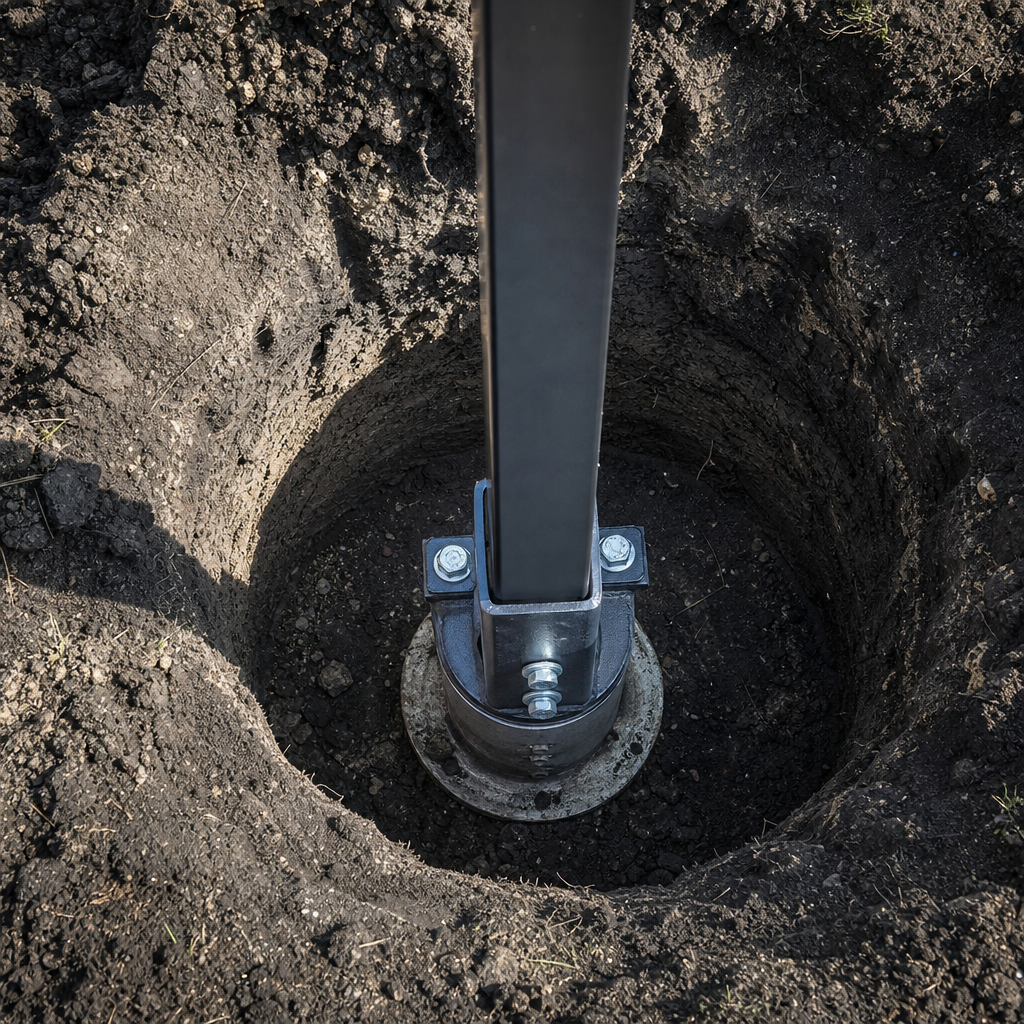
To support gate post stability, helical piers and sleeve-isolated piers serve as possible engineering approaches recommended by firms like Ironworks Gate Co., though they are not universally applicable solutions or guarantees of stability. Site conditions, soil testing, gate loads, and professional engineering review determine the appropriate system.
Helical Piers: Anchoring Below Active Soil Layers
Helical piers use steel shafts with welded screw flights that are mechanically driven into the ground. As a possible engineering approach, helical piers are designed to penetrate shifting upper clay toward load-bearing strata, subject to site-specific geotechnical conditions.
Sleeve Isolation and Deep Concrete Piers
When installing concrete footings, a smooth-wall outer sleeve (such as high-density polyethylene or sonotube forms) placed around the upper portion of the footing is an engineering approach that may reduce clay grip as surrounding ground swells and contracts.
| Feature | Standard Shallow Plug | Sleeve-Isolated Pier | Engineered Helical Pier |
|---|---|---|---|
| Anchor Depth | Shallow (site-dependent, often 2 to 3 feet) | Site-specific depth (drilled foundations in highly expansive conditions may require about 15 feet or more, subject to geotechnical investigation and gate loads) | Site-specific depth driven to load-bearing strata based on geotechnical conditions |
| Clay Grip Mitigation | None (direct soil friction) | Smooth outer sleeve barrier | Slender steel shaft design |
| Seasonal Movement Mitigation | Vulnerable to heave and tilt in expansive soils | Designed to isolate post from upper soil expansion | Designed to anchor post to deeper load-bearing strata |
Re-Plumbing vs. Full Replacement
If an existing steel gate post is structurally sound, thick-walled, and unbent, it may not need total replacement. Based on professional assessment from teams like Ironworks Gate Co., technicians may excavate around the footing, re-align the post with hydraulic equipment, and evaluate structural underpinning or tie-backs depending on site conditions.
Gate Automation Re-Alignment
Need blackland prairie clay gate post repair?
We’re available now - call for a fast, free estimate.
Once the post foundation is addressed, automation equipment may require recalibration by a qualified technician to address mechanical strain caused by previous shifting.
Operator Diagnostic and Reset
As a practical inspection consideration requiring manufacturer or qualified technician confirmation, technicians inspect mechanical linkages, clear electronic error codes, and reset open and close travel limits. Actuator arms should be leveled to support smooth travel along mounting brackets.
Safety Sensors and Hardware Calibration
Ground movement can shift infrared safety photo-eyes out of focus, causing the gate to reverse or remain open. Re-aligning optical sensors, testing underground safety loops, and re-centering magnetic lock armatures are practical maintenance steps requiring confirmation by a qualified technician.
Blackland Prairie Clay Gate Post Repair Considerations
Repair approaches and installation requirements depend on several property variables:
- Gate Weight and Span: Heavy 20-foot wrought iron gates impose different structural demands than lightweight aluminum walk gates, influencing footing design.
- Subsurface Soil Profile: The depth required to reach suitable load-bearing soil varies widely across North Texas depending on specific geological formations and geotechnical testing.
- Power and Solar Setups: Rural acreage or long driveways running on solar panels require low-friction mechanical adjustments so motors draw minimal battery power during movement.
Frequently Asked Questions About Clay Soil Gate Repairs
How deep should gate posts be set in Texas Blackland clay?
There is no single depth that works everywhere. While shallow footings are vulnerable in expansive soils, drilled foundations in highly expansive conditions may require about 15 feet or more, subject to geotechnical investigation, gate loads, and site-specific engineering review.
Can a leaning gate post be straightened without complete replacement?
If the steel post is intact, free of rust-through, and not bent, it may be re-plumbed using hydraulic leveling systems. However, appropriate foundation remediation or underpinning must be evaluated based on site conditions to mitigate future movement.
Do foundation solutions like helical piers suit all gate installations?
Helical piers and deep sleeve-isolated piers are possible engineering approaches rather than universally applicable solutions or guarantees of stability. As Ironworks Gate Co. explains, footing design depends on total gate weight, local soil composition, site access, and geotechnical investigation. An on-site engineering evaluation determines the appropriate solution for the property.
Disclaimer: The provided research does not document a gate-post repair case study, quantified repair success rate, or verified Fort Worth repair frequency.
Need blackland prairie clay gate post repair?
We’re available now - call for a fast, free estimate.
Sources
- DFW – Monthly and Annual Precipitation – National Weather Service – weather.gov (2026)
- Gridded Soil Survey Geographic Database (gSSURGO) – agdatacommons.nal.usda.gov (2023)
- The Blackland Prairies – TPWD – Texas.gov – tpwd.texas.gov
- The Real Dirt on Austin Area Soils – Urban Programs Travis County – travis-tx.tamu.edu
- Houston Black – pssat.org
Related reading: Compare Gate Repair Services Fort Worth – Call Now-10% Off – On-Site in 60 Minutes – Free Estimate
Related reading: Gate Repair Fort Worth Tx – 10% Off & Free Estimate – On-Site in 60 Minutes
Related reading: Ironworks Gate Co Emergency Service | 10% Off & Free Estimate | On-Site in 60 Minutes
Frequently Asked Questions
Can continuing to operate a gate on a shifting clay post ruin the automatic opener?
Yes. When soil movement tilts a post, the resulting hinge friction and track binding force opener motors to push against severe resistance, risking stripped gears, blown fuses, and burned-out circuit boards. Ironworks Gate Co. recalibrates operators and realigns safety sensors alongside foundation stabilization to prevent permanent automation damage.
Why is adding a surface concrete collar ineffective for stabilizing a leaning post?
Pouring extra concrete around the surface merely adds weight within the upper soil layer, where expansive Blackland Prairie clay swells and contracts most aggressively. Ironworks Gate Co. replaces ineffective surface collars with deep sleeve-isolated footings or engineered helical piers that bypass the active clay zone entirely.
How do I determine the right foundation repair method for my shifting gate?
Foundation design depends on total gate weight, local soil composition, and site-specific load demands. You can schedule a free on-site gate assessment with Ironworks Gate Co. to inspect your post deflection and receive a transparent, fixed-price repair quote.
About the author
 |
Sarah Jenkins Sarah Jenkins has over 10 years of experience in the automated gate and access control industry, working closely with both residential and commercial clients across the Dallas-Fort Worth metroplex. She specializes in writing clear, actionable guides on gate maintenance, repair diagnostics, and transparent pricing structures. Sarah holds a degree in Technical Communication from the University of North Texas. |
Gate not opening, off track, or opener dead?
We’re available now - call for a fast, free estimate.
Call Now - Free Estimate