
A Linear Gate Opener That Won’t Run Usually Comes Down to Four Things
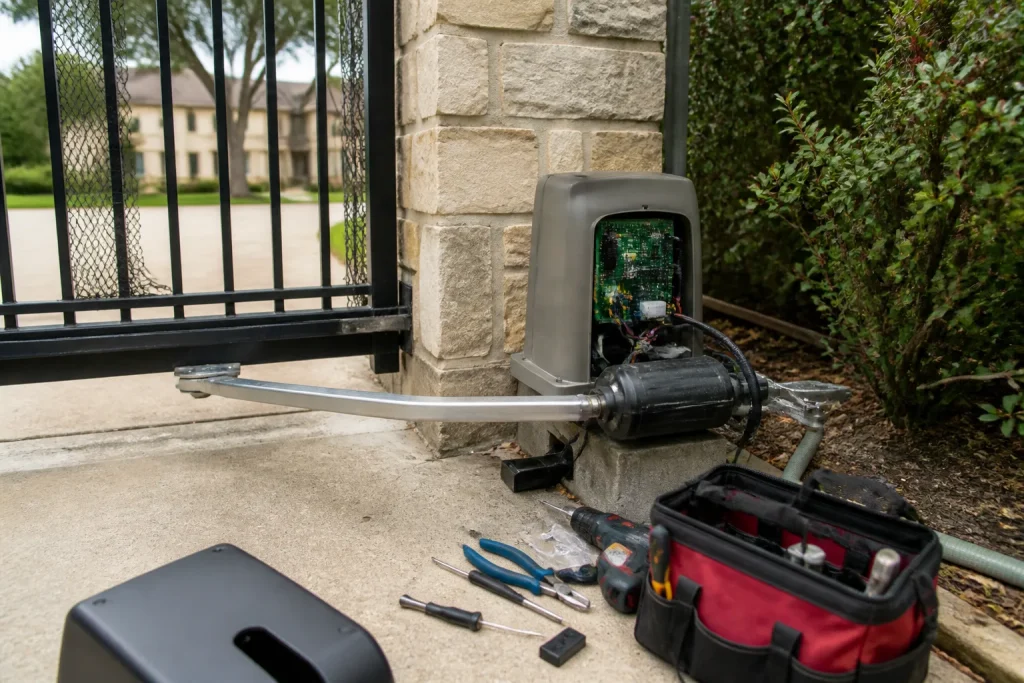
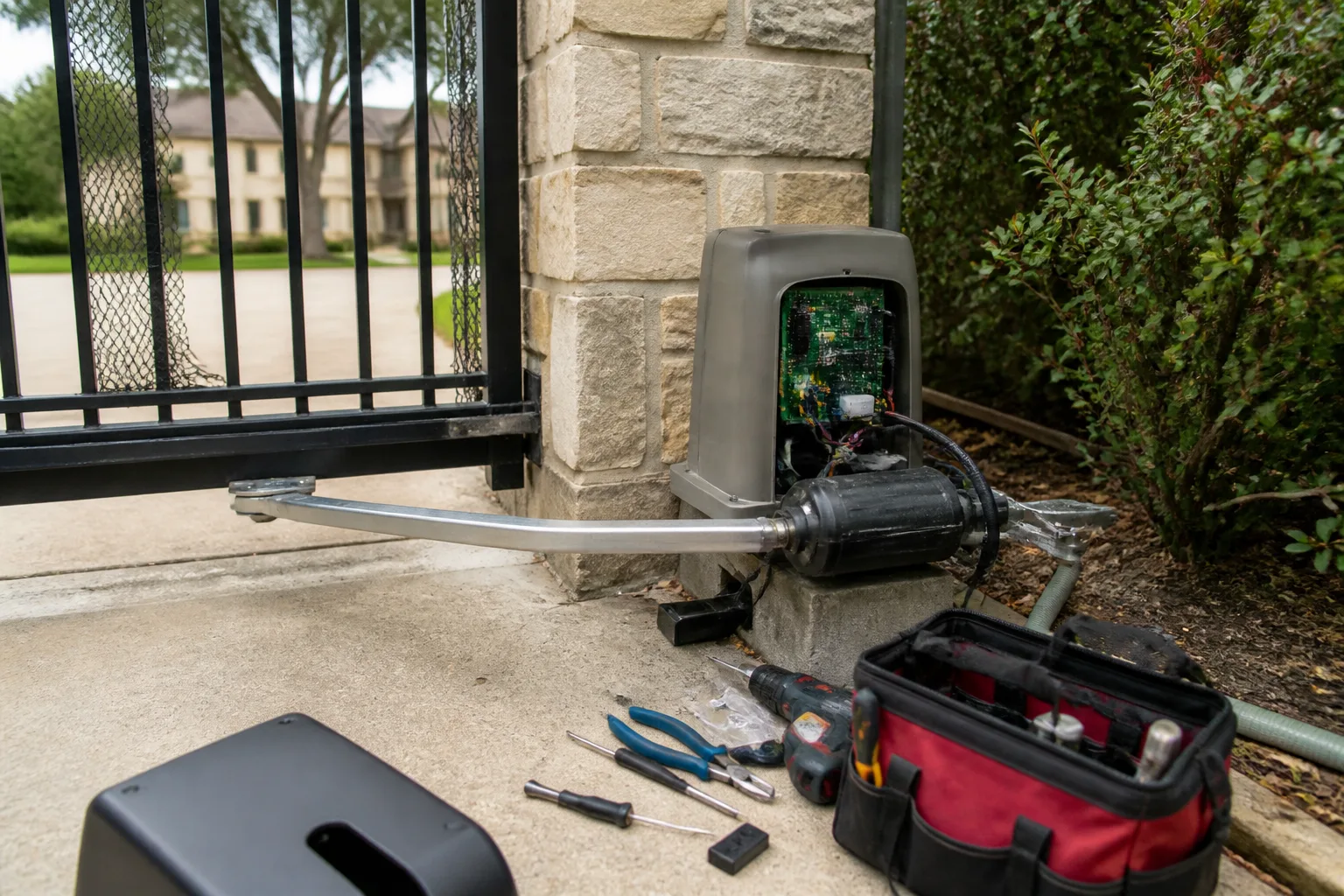
Most Linear gate opener failures in Fort Worth trace back to one of four components: the battery, the capacitor, the limit switch, or the control board. The first three are typically under $80 in parts and fixable in a single visit. The fourth is where good money gets thrown after bad, because a homeowner who brings a technician out and says “the opener’s dead” without one useful detail almost always gets sold a full replacement whether they need one or not.
If you’d rather not chase down the diagnosis yourself, call (817) 562-7979 and one of our techs will sort it out on site. But if you want to know what you’re dealing with before the truck rolls, read on. We wrote this because we’d rather see you armed with good information than quoted for a $1,400 opener replacement when a $14 capacitor would’ve had you running again by lunchtime.
Reading Linear’s Fault Codes Before You Pick Up the Phone
Linear pads their control boards with a diagnostic feature that most homeowners never use. The board has a small LED that blinks in patterns, and each pattern corresponds to a specific fault. You don’t need to memorize all of them. You need to know five. Here’s what we see most in Fort Worth:
- One blink: Obstruction detected. Something’s in the way of the gate’s travel path, or the safety edge is misaligned. In Tarrant County clay soil, a gate post that shifts even a quarter inch throws the photo eye out of line and trips this code constantly. It’s not a motor problem. Don’t let anyone sell you a motor for it.
- Two blinks: Reverse battery polarity or a battery that’s gone too low to hold the board’s logic. Common after a summer of 100-degree days cooking the battery in its housing.
- Three blinks: Excessive force trip. The opener pushed harder than its setting allows, shut itself off, and now refuses to move. This is a symptom, not a cause. Sand and silt from Fort Worth’s hot, dry summers collect in the track and create drag that the opener interprets as hitting something.
- Four blinks: Thermal overload. The transformer ran too hot, usually because the gate’s been cycling more than it was sized for, or the capacitor’s fading and the motor’s working harder to compensate.
- Five blinks: Communication fault between the board and the receiver or a shorted accessory wire.
Write down which blink pattern you’re seeing before you call anyone. A technician who asks you to check that light is doing diagnostics. A technician who doesn’t is guessing, and in our 42 years of doing this we’ve watched too many homeowners in Fort Worth pay for guesses.
Why Fort Worth’s Clay Soil Fakes Out Homeowners
Expansive clay is the quiet villain behind a surprising number of Linear “opener failures” in Fort Worth. Here’s what happens: the soil under your gate posts swells when it rains and shrinks in the summer heat. The post shifts. The gate sags a fraction of an inch. That fraction of an inch changes the arc of the gate’s swing, so the gate now binds against the catch or drags along the track at a spot it cleared fine last month.
The opener, being a dumb machine with a job to do, responds to that added resistance by pushing harder. The force sensor trips. The gate stops midway. The homeowner assumes the opener’s failing and calls for a repair. A good technician tests the gate’s swing manually before touching a single wire. If the gate is hard to move by hand, that’s a hinge, a post, or a sagging frame, not a Linear board or motor. The fix is mechanical: shim the post, re-hang the hinge, weld a reinforcement plate. Leave the opener alone. We’ve been called out to neighborhoods in Wedgwood, Ryan Place, and over in the newer subdivisions north of Alliance where the same story played out: opener gets the blame, post gets the truth.
If the gate swings freely by hand but stalls under power, then we start looking at the opener itself. That’s the difference between a $125 post adjustment and a $700 board replacement, and it’s why we test with muscle before we test with a meter.
The Linear Models You’re Most Likely to Have in Fort Worth
Fort Worth’s subdivisions went up in waves, and the gate openers followed. The linear operators we service most in the area break into three groups:
- Linear LDO50 and LDO33: Common on single-swing driveway gates in older neighborhoods built from the 1990s through about 2010. These units are simple and tough, but the run capacitor tends to fade after 8 to 12 years. When a capacitor goes, the motor hums but can’t start under load, and the gate either creeps or sits dead. It’s a $20-$40 part. It is not a replacement situation.
- Linear Pro Access APeX series: Found more on newer estate properties and gated communities, especially on the west side of Fort Worth toward Aledo and out toward Benbrook. These are smarter boards with more fault logging. The weak point here is the control board’s relay contacts, which pit and corrode with age, especially in garages that get hot enough to bake the electronics.
- Linear Smart Garage and gate combo units: The homeowner-grader stuff we see at retail. These aren’t bad for a single gate on a flat lot, but Fort Worth’s heat kills the plastic limit switch gears faster than anything. Once the limit switch strips, the opener loses its place and either over-travels or stops short.
Knowing your model helps, but the symptom tells us more than the model number. A hum that won’t start is not the same repair as a gate that slams shut at full speed, and the two don’t share a price tag.
What a Legitimate Linear Repair Visit Should Include
If you call a repair outfit for a Linear opener, here’s what should happen during the visit. This is the standard we hold to, and it’s the standard any honest shop will match:
- Manual gate test first. The tech should run the gate by hand to isolate mechanical drag from electrical fault. Skip this step and you’re skipping the diagnosis.
- Limit switch calibration. Linear units depend on precise travel limits. If the switch is off by even half an inch, the opener pushes too hard at each end and eventually trips the force sensor or burns the motor. A proper repair includes setting the limits and testing the gate at both ends of travel.
- Obstruction force testing. The opener should reverse or stop when it hits resistance. A tech who doesn’t test this is leaving you with a gate that could hurt someone, or a gate that reverses because a lizard farted near the photo eye. Both extremes are wrong. We test the actual force setting and adjust it to the gate’s weight.
- Terminal block inspection. Loose or corroded terminals cause intermittent failures, which are the worst kind because the gate works when the tech arrives and fails again at midnight. A competent tech pops the board cover, checks every connection, and tightens the ones that have worked loose.
- Battery health check, if equipped. Linear units with battery backup need that battery load-tested. A battery that reads 12 volts sitting idle can collapse under load and leave your gate dead during a power outage, which is when you actually need it.
We pulled a Linear APeX out of a garage in Overton Woods last month where the owner had paid another company twice for the same intermittent failure. The problem was a corroded terminal block from a garage that leaked humidity every summer. Two visits, two service charges, no terminal inspection. Twenty minutes with a wire brush and some dielectric grease solved it. That’s the kind of thing that should’ve been caught the first time, and it’s why we show our customers the actual fault before we fix it.
Repair vs. Replacement: The Honest Math
The question every homeowner asks: fix it or replace it. Here’s our rule of thumb, and we’ve been consistent on this for as long as we’ve hung the Ironworks shingle.
If the opener is less than 10 years old and the failure is a capacitor, battery, limit switch, or even a control board on a standard unit, repair is almost always the honest answer. The parts are available, the labor is straightforward, and you’re back to a working gate for a fraction of replacement cost. We’ve done capacitor swaps on Linear units that are still running fine eight years later. A $35 part should not trigger a $1,300 install.
If the opener is past about 15 years old, or if the symptom points to a motor that’s drawing excessive amperage and running hot, replacement starts to make sense. Mechanical wear can’t be reversed. A motor that’s burning through capacitors repeatedly is telling you something about its future, and at that point you’re paying in installments for a new opener while still owning an old one.
One more consideration specific to Fort Worth: if your gate is part of a larger driveway system with keypads, vehicle loops, or a phone entry panel, and those need service anyway, a bundled replacement with modern Linear equipment can simplify your setup. We don’t push this. But we will tell you when keeping an old unit alive stops making financial sense, and we’ll put that recommendation in writing with a real price before we touch anything.
We also work on FAAC, BFT, and Viking openers, so if your gate’s been running on a mixed system or you’re not sure what’s on the post, we’ll identify it and give you the straight answer for whatever brand is there.
When to Call a Pro
You can read the fault codes and test the gate by hand, and that’s real progress. But there’s a point where good information meets hard equipment, and past that point you want a professional.
If the gate doesn’t move by hand, call us. If the opener hums but won’t run, call us. If the fault light shows something besides a clean pattern, call us. If the gate reversed itself into a car or a kid, call us immediately and don’t run it again. High-tension springs, heavy gate leaves, and 120-volt control wiring are not things to experiment with. A swinging gate carries enough weight to break a leg or worse. We’re trained for this, and we do it every day, and we’d rather come fix a $75 problem than see a homeowner hurt themselves saving a service call. Your home comes first. That’s not a slogan. It’s the order of operations.
Related services if this article hit close to home: our Gate Repair in Fort Worth page covers full diagnostic visits, and if the hinge or post is the true culprit, we handle that work too. For openers beyond repair, see Gate Motor & Opener in Fort Worth. And if you’re new to gated living or replacing an old beast, Gate Installation in Fort Worth walks through what a proper install includes. Every job we do traces back to the same promise: Ironworks Gate Co. home is where you’ll find a live person on the phone 24/7 and the 90-Day Done Right Promise on every invoice.
The Bottom Line
Linear openers are durable, honest machines. They fail in four predictable places, and three of those places are cheap fixes. The fourth, the control board, is where homeowners on a bad day get talked into spending three times what they need to, because the company on the other end of the phone knows they can. Don’t give them the chance. Read your fault code, test your gate by hand, and call a shop that asks about the blink pattern instead of launching straight into a replacement pitch.
If you’re in Fort Worth and your Linear gate is acting up, call (817) 562-7979. Estimates are free, the price gets settled before a single bolt turns, and everything we do is backed by a written 90-Day Done Right Promise. We’ve been serving Fort Worth since 1984, and we plan on answering that phone for another forty years.
Frequently Asked Questions
Most Linear gate repairs in Fort Worth run between $125 and $450 depending on the part. A capacitor or battery swap is on the low end, limit switch replacement lands a bit higher, and control board replacement is typically the upper end. The price is quoted and agreed before any work starts, and you’ll never see a surprise on the invoice. Call (817) 562-7979 for a free estimate on your specific opener.
Four blinks on a Linear board indicates thermal overload, which means the transformer or motor has gotten too hot. In Fort Worth’s August heat, that’s often caused by a failing capacitor forcing the motor to work harder than it should. Other causes include a gate that’s binding and increasing current draw. This is one of the call-us situations. We test the motor’s amp draw and the gate’s manual swing before recommending a fix.
If the opener is under 10 years old, repair is almost always the honest route. The capacitors, batteries, limit switches, and even control boards on Linear units are serviceable parts, and replacing one is far cheaper than replacing the whole opener. If the motor itself is worn and drawing excessive current, or the unit is past 15 years, we’ll tell you straight and give you a written replacement price so you can think on it.
A live person answers our phone 24 hours a day, 7 days a week, including weekends and holidays. We’ll get a tech scheduled for your Linear opener as soon as the next opening allows, and many repairs are completed same-day depending on how the schedule sits and what the diagnosis shows. Call (817) 562-7979 and tell us what your fault light’s doing.
Written by Victor Salinas, Owner at Ironworks Gate Co., serving Fort Worth since 2013.
Need Gate Repair Help?
Call Ironworks Gate Co. - licensed & insured, available 24/7 in Fort Worth.
(817) 562-7979